
Dock Seals vs. Dock Shelters: Which One Does Your Western New York Loading Dock Need?
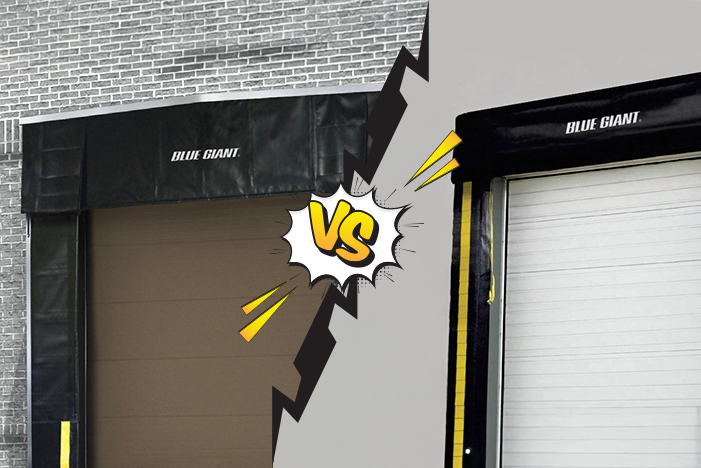
Here is the short answer. Dock seals are foam pads that a trailer presses into when it backs in. Dock shelters are a frame with fabric curtains that hang around the trailer instead of pressing against it. Seals block cold air better. Shelters leave the doorway clear and fit a wider range of trucks.
Both products close the space between a truck and your building, which is why they get talked about as one thing. But they are different. The option that suits a busy distribution center may not be the same as the one that fits a plant that takes deliveries in five different truck sizes.
Choosing wrong can cost you on the heating bill and slow down every load. In a region like Western New York, where over 100 inches of snow isn’t out of the ordinary, that first cost will show up quickly.
How dock seals and dock shelters work
What is a dock seal?
Dock seals are foam pads mounted on the top and both sides of the door. The truck backs in and squeezes against them. They narrow the opening, but they are the tightest weather barrier you can put on a loading dock. Because the fit depends on squeeze, the pads have to be sized for the trucks that actually visit you. If you set them up for a 53 foot trailer, a shorter, narrower one will barely touch them. Go the other way and every arrival crushes the foam harder than it should, which wears the pads out sooner. For that reason, they are best for buildings where most trucks are close to the same size.
What is a dock shelter?
Dock shelters use a frame holding fabric curtains that drape against the truck rather than pressing into it. Nothing sticks out into the doorway, so the whole opening stays usable. That matters if you load two pallets side by side, move wide freight, or stack close to the trailer roof. It also helps if your yard is tight and drivers back in at an angle, because a shelter is more forgiving of a crooked approach. They are a good choice for warehouses or facilities that take a range of different truck sizes or move wide loads.
Here’s how the two compare side by side:
| Dock seals | Dock shelters | |
|---|---|---|
| How it works | The truck presses into foam pads | Fabric curtains hang around the truck |
| Weather barrier | Tightest option | Good, but looser |
| Doorway | Narrows the opening | Leaves it fully open |
| Truck sizes | Needs a consistent fleet | Handles a wide range |
| Wear | Foam compresses on every load | Less contact, less wear |
| Best for | Steady truck sizes, cold sensitive product | Mixed fleets, wide loads, heavy traffic |
What about inflatable seals and shelters?
The third option is seals and shelters that inflate around the truck once it parks, so you get a clear doorway and a snug fit at the same time. The downside is that inflatable options typically cost more and have more parts to look after.
Are dock seals or dock shelters better for a Buffalo winter?
An open loading dock is one of the biggest holes in a heated warehouse, and around here it stays open through some rough winter weather. National Weather Service records for Buffalo show seasonal snowfall above 100 inches in 2010-2011, 2013-2014, 2014-2015, 2017-2018, 2018-2019, and 2022-2023. December 2022 brought 64.7 inches in a single month. Lake effect off Erie and Ontario dumps huge amounts of heavy snow, and winds blow it sideways, pushing it into any gap a dock opening leaves.
Winter weather plays out three ways at a loading dock:
- Warm air escapes at the door, so your heater has to run longer to keep up.
- Snow and moisture blow in, then freeze and lead to slippery, dangerous surfaces.
- Frigid air reaches products that were never meant to sit in the cold.
When it comes to weather alone, a compression seal wins. If your trucks vary in size, however, a seal that only fits half of them is not sealing much, and a shelter or an inflatable unit will hold more heat inside and keep more of the elements out.
Five things to check before you choose
1. What kinds of trucks back in. This decides most of it. If nearly everything is a 53 foot dry van, a compression seal is straightforward. If you take a mix of 48 foot trailers, straight trucks, box trucks, and refrigerated units, a shelter or an inflatable will serve you better.
2. How much doorway you need. Measure the widest load your forklift carries through the door. If it is close to the door width, a seal takes away clearance you can’t spare.
3. How high you stack. Freight loaded near the trailer roof needs clear space overhead at the door. Top pads on a compression seal can get in the way.
4. How many trucks a day. A door that turns twenty trucks a day squeezes the foam twenty times a day. Busy openings wear seals out faster, which may call for a shelter or a heavier duty material.
5. How trucks pull in. Angled drives, tight lots, and blind side backing all mean trucks land off center. Dock shelters put up with that better than dock seals.
What other loading dock solutions do you need?
Seals and shelters handle weather. They do nothing about the gap between the trailer bed and your floor, a truck that creeps away mid load, or a driver who can’t see when to pull out. That is the job of the rest of your loading dock equipment: dock levelers, vehicle restraints, dock lifts, and dock lights.
If you are working through a full pre-winter check, our post on loading dock tips for the winter months covers inspection and upkeep across all of it.
Talk to JIT Toyota-Lift about loading dock equipment
JIT Toyota-Lift carries Blue Giant dock seals and shelters, including compression seals, stationary and retractable shelters, inflatables, metal canopies, and rain shrouds. These types of equipment take wind, ice, and road salt year after year, so what they are made of matters. Blue Giant offers ArmorShield, a heavy duty material designed to extend the life of seal and shelter units, along with rust proof metal canopies that keep snow, ice, and rain off the bay. We also offer additional Blue Giant loading dock solutions, including dock levelers and loading dock lights.
If you are not sure which one fits your facility, contact our team. We will look at your warehouse, the trucks that come in, and your door openings, then tell you which dock solutions will work best. We serve Erie, Chautauqua, Niagara, Cattaraugus, Wyoming, and Allegany Counties from our Frewsburg and Cheektowaga locations.
Frequently asked questions about dock seals and shelters
A dock seal has foam pads that a truck squeezes against, which blocks weather well but narrows the doorway. A dock shelter is a frame with fabric curtains that hang around the truck, which keeps the doorway fully open but lets in a little more air.
A properly sized dock seal gives the better weather barrier. A shelter gives up some of that for a clear doorway, and an inflatable unit gets you close to both.
No. Compression seals are sized for a set range of trailer dimensions. If a wide mix of trucks backs into your dock, a shelter or an inflatable will fit more of them.
Usually. The right unit depends on your door size, the wall around the opening, and how trucks approach, which is why a site visit comes before a recommendation.
Price depends on the size of your openings, the material you choose, and whether you go with a compression seal, a shelter, or an inflatable unit. Contact JIT for a quote on your specific doors.
Dock levelers, vehicle restraints, and dock lights all take a beating in this climate. Our winter loading dock post walks through what to look at on each one.